Christmas Decor for Small Spaces: Make Room for the Season
, by LignovanciaAtelier, 4 min reading time
, by LignovanciaAtelier, 4 min reading time
You don’t need a full-size tree or a spare room for decorations. A few well-placed details can bring Christmas into a small home without taking away the space you need to live.
In a small home, Christmas decorating comes with a practical question: where will everything go?
The coffee table already holds your evening tea. The dining table doubles as a desk. And the corner that looks perfect for a tree is also where the cupboard door needs to open.
Instead of squeezing in a smaller version of every traditional decoration, choose a few places where the season can settle naturally. The best Christmas decor for small spaces leaves room for ordinary life: somewhere to put a plate, open a book, and sit comfortably with someone you love.
Choose the place you notice most when you come home. It might be a narrow console, a shelf opposite the sofa, or the end of a kitchen counter. Make that your main festive moment, then let the rest of the room stay relatively quiet.
Try a simple arrangement: a vase of branches, a favorite decorative object, and a small pool of warm light. Move a few everyday items out of the way first. Creating space around an arrangement often does more than adding another ornament.
A useful test: if decorating means you have nowhere to put your keys, edit the display.
A full-size tree is lovely, but it isn’t the only way to bring a sense of Christmas indoors. A few branches in a stable vase can give you height and a place for two or three lightweight ornaments without occupying the floor.
Keep the proportions modest. The arrangement should feel balanced in its container and stay clear of lamps, curtains, and walkways. If you use fresh greenery, choose something suitable for your household, especially if you have pets or young children.
The vase needn’t look seasonal. An expressive ceramic shape or a familiar vessel you use throughout the year gives the arrangement a more personal starting point. Once the holidays are over, replace the branches with flowers, or simply enjoy the vase on its own.
Bookshelves are useful decorating space because they don’t ask you to give up another surface. But adding Christmas decorations to every gap can make a small room feel crowded.
Clear one section instead. Keep a short stack of books, add a small sculptural object, and introduce a seasonal detail such as a ribbon or a single ornament in a shallow dish. Leave some of the shelf visible.
Wood, ceramic, paper, and fabric can sit together beautifully here. Repeat a color already in the room rather than introducing an entirely new palette. Cream ribbon beside pale ceramics, or deep red against dark wood, can feel festive without turning the shelf into a shop window.
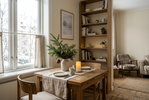
On a small dining table, a centerpiece should earn its place. If guests have to move it before anyone can pass the bread, it is probably too large.
Use a narrow runner or a folded length of fabric to define the center. Add one low arrangement, then leave generous space for serving dishes and glasses. A small decorative piece at each place can make the table feel considered without requiring an elaborate display.
If your table is also your workspace, build the arrangement on a tray. You can move it to a sideboard in the morning and bring it back for dinner. Christmas decorating works better when it fits your routines rather than interrupting them.
When there is little room left for decorations, change the light. A warm table lamp or a short strand of indoor-rated lights can shift the mood without covering another surface.
Battery-operated LED candles are a practical choice for shelves and compact arrangements. If you use real candles, place them in suitable holders on a stable, heat-resistant surface, well away from greenery, ribbon, paper, and curtains. Never leave them burning unattended.
Give windowsills the same practical attention. Keep windows usable, vents clear, and electrical leads out of the way. A softly lit window should still be a working part of your home.
Storage is part of decorating a small home, even if it is less exciting than choosing ornaments. Before buying something new, think about where it will live in January.
One approach is to make everyday objects the foundation of your Christmas decor. A vase, a wooden accent, or a small animal figure can belong in the room all year. Seasonal ribbon, branches, and a handful of treasured ornaments provide the temporary layer.
At Lignovancia, we’re drawn to objects with character: an interesting silhouette, a tactile surface, a detail that makes you look twice. Those qualities don’t expire when the tree comes down.
Before adding the final few decorations, sit where you usually spend the evening. Can you still reach your drink? Is there a clear place for a guest to sit? Does the room feel inviting, or simply full?
You don’t need to decorate every corner to make Christmas feel present. A few branches catching the light, a table ready for supper, and a familiar object wearing a little ribbon may be enough.
A small home doesn’t need a bigger Christmas. It needs room to enjoy the one you make.


